



Navigating tech uncertainty
Equity markets gave back some of the gains recorded in recent months, as the AI and semiconductor complex that had driven this year’s rally led the pullback, while renewed tensions in the Middle East pushed oil prices higher, reversing the prior period’s decline. Asia led on the way down, having led on the way up. Japanese and Korean indices set fresh records midway through the period before moving into correction territory, although Korea and Taiwan remained the clear year-to-date leaders. The catalyst was growing scepticism over the pace and eventual payoff of AI infrastructure spending, which triggered a broad unwind of crowded semiconductor positions across the region.
The US proved more resilient, supported by a cooler inflation print and a strong, bank-led start to the Q2 earnings season. Indices set fresh highs before the chip sell-off trimmed gains. The Federal Reserve maintained a hawkish tone, with inflation still above target and a further rate hike still in play, while firmer oil prices kept price pressures in focus.
Europe rebounded to fresh record highs, supported by a broadening rotation into cyclicals, industrials, financials and defence. Its lighter technology weighting also helped cushion the impact of the semiconductor sell-off. Year to date, Asia continues to lead by a wide margin, but both the United States and Europe remain firmly positive, with rising earnings more than offsetting valuation compression across markets.
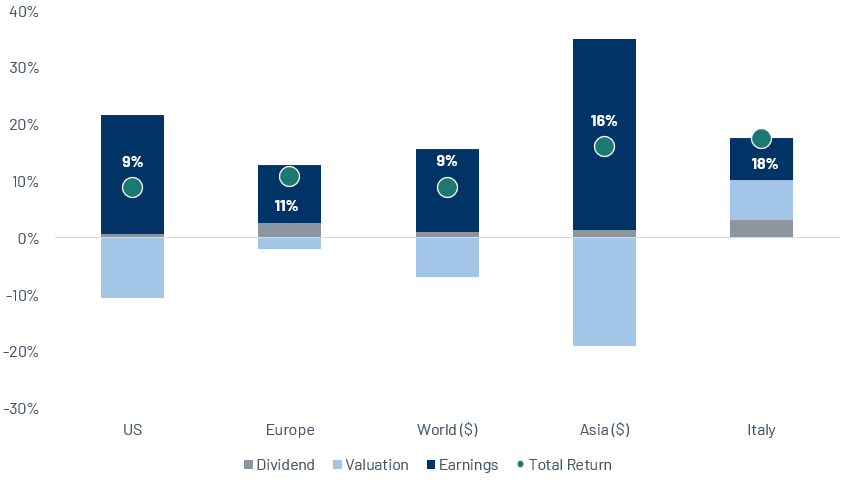
Source: Algebris Investments, Bloomberg Finance L.P, data as 17/07/2026. Performances in local currencies
Leaders turn laggards in rotation
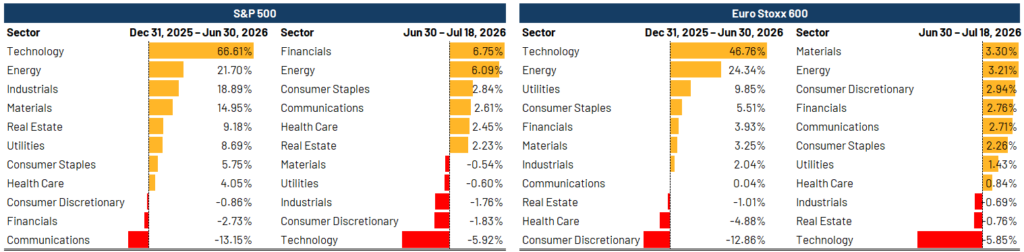
Sector rotation has been a dominant market theme over the past month. Sentiment towards technology, the best-performing sector since the beginning of 2026, has turned sour, while defensive names are outperforming.
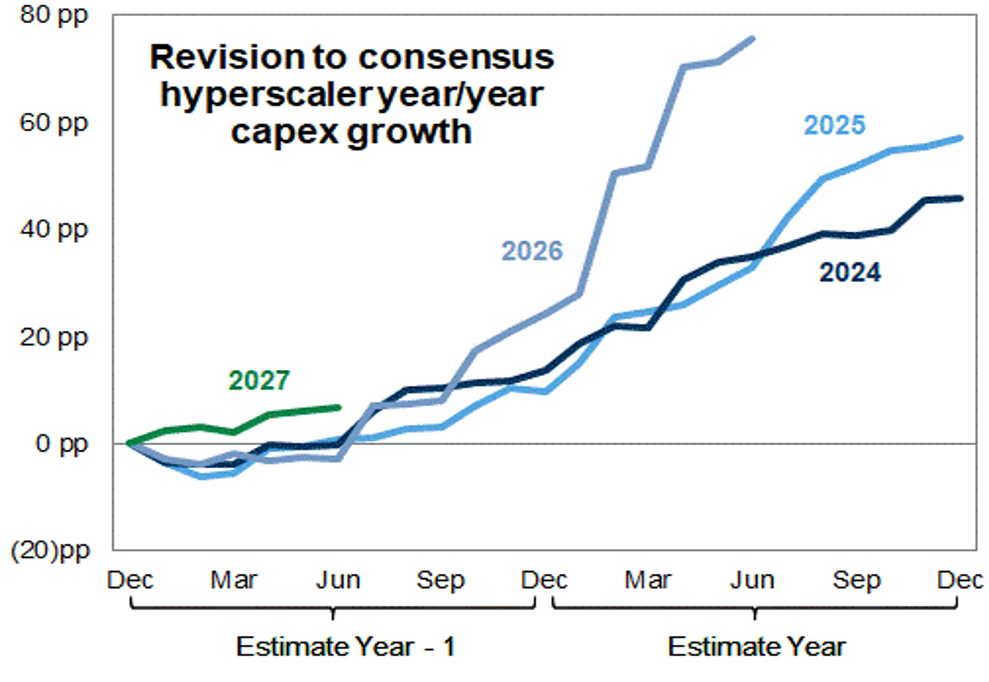
Powered by the AI infrastructure build-out, technology was, by a wide margin, the top-performing sector in both the S&P 500 (+67%) and the Euro Stoxx 600 (+48%) between December 2025 and June 2026. However, since the end of June the scenario has reversed, with technology becoming the single worst-performing sector in both indices. Capital has rotated aggressively out of AI-related stocks, reflecting growing concerns about infrastructure overcapacity, uncertainty around the return on the massive investments made, stretched valuations, and potential demand moderation. The delayed OpenAI IPO and intensifying competition from Chinese models have added to this wall of worry. Fundamentals, however, continue to look strong: analysts continue to revise upwards consensus forecasts for hyperscaler capital expenditure (capex), a key metric for the sustainability of the AI trade, signalling that companies are not pulling back on investment for the time being.
The second-quarter reporting season has just started. ASML and TSMC have been among the first companies to report. Despite both beating estimates and raising future targets, the market reacted negatively. With most large hyperscalers and AI infrastructure names still to report in the coming weeks, this earnings season should offer a clearer indication on whether fundamentals hold, paving the way for the market to reevaluate, or not, its stance on the technology sector.
From 3310 to Pro: The silicon survival game
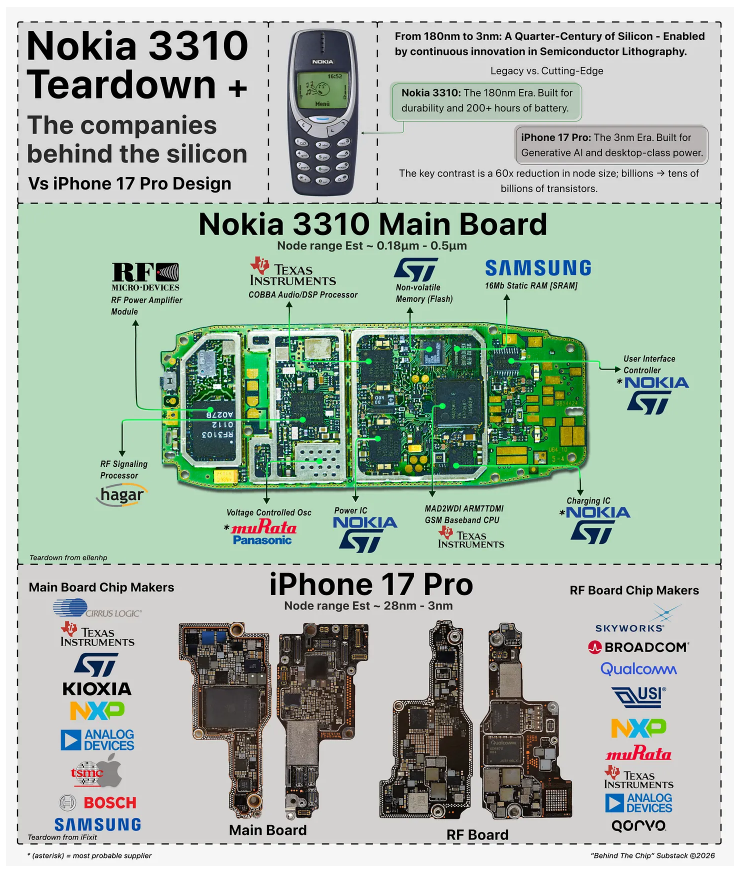
Few comparisons illustrate the pace of semiconductor progress as clearly as placing a Nokia 3310 next to an iPhone 17 Pro. Released a generation apart, the two devices reveal just how far the semiconductor industry has travelled over the past twenty-five years, and how, for these companies, innovation is not merely about pushing technological boundaries, but a matter of survival.
The Nokia 3310, one of the best-selling phones of its era, was refreshingly simple: its board relied on a handful of chips from a rather limited list of suppliers (Texas Instruments, STMicroelectronics, and a few others), handling every function from audio processing to memory to power management. The iPhone 17 Pro tells a completely different story: it’s packed with far more complex chips, sourced from a dozen specialised manufacturers, each contributing highly specialised silicon for tasks such as 5G connectivity, AI processing, and advanced computing power.
This transformation mirrors a broader shift within the semiconductor industry itself. Twenty-five years ago, a handful of vertically oriented suppliers could credibly cover several key functions of an electronic device. Today, no single company can span the full stack: chip design has fragmented into deeply specialised niches. STMicroelectronics illustrates this dynamic well. As one of the suppliers present on the Nokia 3310’s board decades ago, STM has had to continuously reinvent its position as technology advanced, new competitors emerged, and the industry moved through successive waves: automotive electrification, industrial automation, and now AI-driven data-centre demand.
This is, ultimately, the defining feature of the semiconductor sector: it rewards continuous reinvention and punishes complacency. Innovation here is not merely a matter of technological advancement, it is a survival mechanism.
Algebris Investments’ Global Equity Team
For more information about Algebris and its products, or to be added to our distribution lists, please contact Investor Relations at algebrisIR@algebris.com. Visit Algebris Insights for past commentaries.
Any opinion expressed is that of Algebris, is not a statement of fact, is subject to change and does not constitute investment advice.
No reliance may be placed for any purpose on the information and opinions contained in this document or their accuracy or completeness. No representation, warranty or undertaking, express or implied, is given as to the accuracy or completeness of the information or opinions contained in this document by any of Algebris Investments, its members, employees or affiliates and no liability is accepted by such persons for the accuracy or completeness of any such information or opinions.
© Algebris Investments. Algebris Investments is the trading name for the Algebris Group.
