
Europe has never entered September with this little gas in store. The EU Storage Regulation establishes a 90% target for gas storage filling across the Union to be achieved between 1st October and 1st December. Deviations of up to 10 percentage points are allowed, with an extra 5 points flexibility in case of “unfavorable market conditions”. This brings the binding operative floor to 80% in normal times, and 75% at a stretch in bad times.
Europe’s gas buffer is unusually thin after a record hot summer (Figure 1). EU gas storage was 65.9% full on 2 September, the lowest reading for the same date in a series that begins in 2011. As a comparison, storage was 78.3% at the same time of year in 2025, and the median reading for the 2015–24 period was approximately 88%. Current storage levels sit below even early September 2021, at 67.9%, a time when Russia had yet to invade Ukraine and gas had yet to become a major geopolitical concern in Brussels.
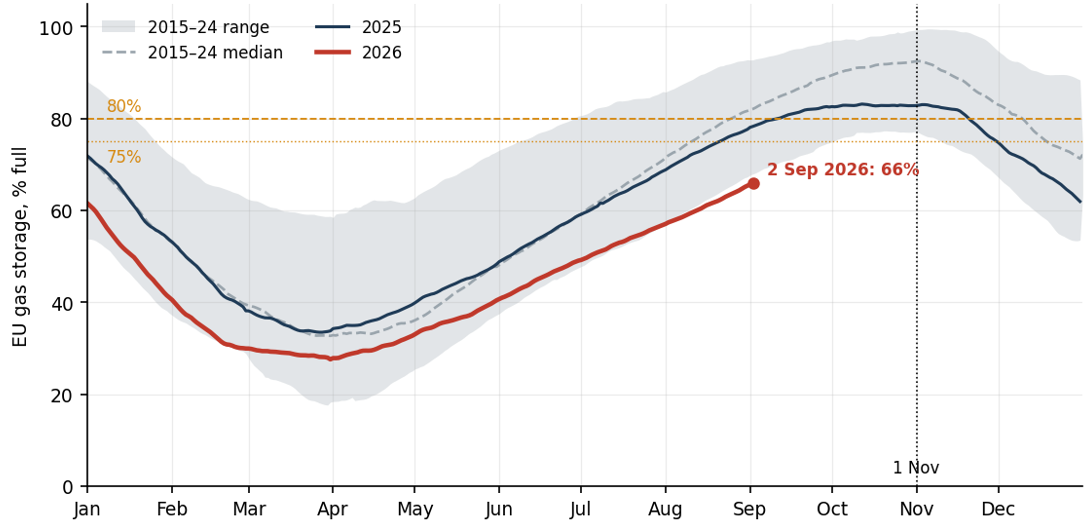
Source: Gas Infrastructure Europe (AGSI), 2 September 2026
The EU aggregate is mostly driven by Germany’s storage shortfalls. Germany operates Europe’s biggest storage system – 246.5 TWh or roughly 22% of EU capacity – which was only 51% full in late August against 69% a year earlier. In part, this problem descends from Germany entering the 2026 injection season with storage left at near 20% after a cold winter. But regulatory factors may have played a more important role. The German government in fact removed two regulatory mechanisms that had helped fill its storage since 2022: the national November target was cut from 90% to 70%, and the storage levy funding state-backed purchases was scrapped from January 2026. In August the Economy Ministry argued that 60–70% storage at the start of winter would be adequate and argued that filling German storage is a job for market players. But the market has not stepped in, because it is not profitable do so: the gas forward curve is flat through winter, meaning that gas bought today to sell in January locks in a loss, a point German operators have made publicly.
Relying on the legislated storage flexibility exposes Europe to the whims of the weather (Figure 2). Eurostat publishes EU27 population-weighted heating degree days (HDD) –which measure how much and for how long the outside air temperature falls below a specific base point that triggers heating need. This data shows that the last three winters have been among the mildest on record in 45 years. If that mildness repeats in 2026, a storage level of 70-75% would allow Europe to end March in the low twenties – thus easing pressure on refilling. But weather is highly uncertain and a colder than expected winter may force storage into the single digits at the turn of the season unless demand compression comes into play.
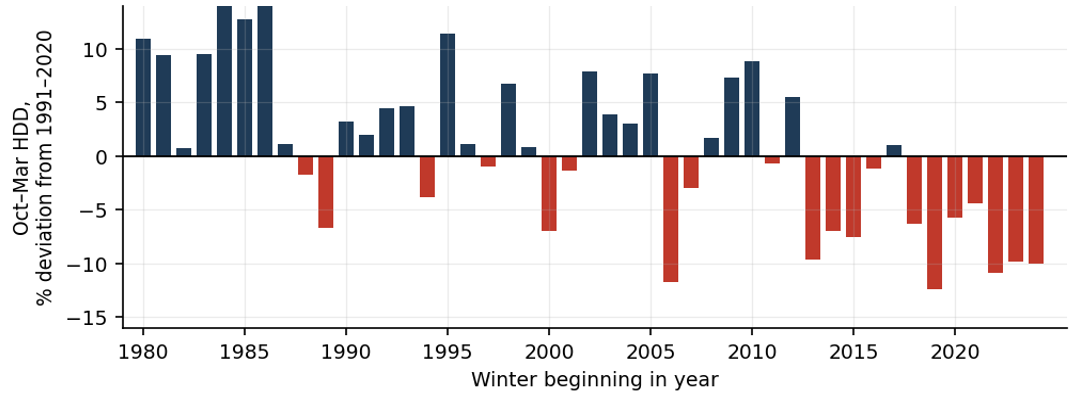
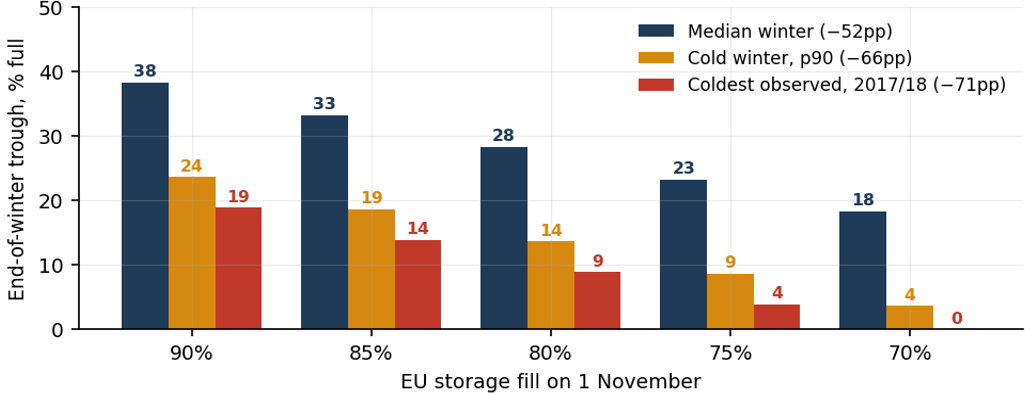
Sources: Eurostat nrg_child_m, EU27 population-weighted heating degree days (ferwer HDDs = milder winter); Gas infrastructure Europe (AGSI). Drawdowns are the 1 Nov-to-trough declines observed in 2011-25; realised drawdown is endogenous to price, so a high-price winter draws lessa and these troughs are conservative.
Getting to the 80% target by November requires a record pace of injections. Injections in 2026 are running 16% below last year in absolute terms and hitting the EU target from today’s 66% storage level would require injections of 14.2pp in the 60 days to 1 November. For comparison, the largest injection ever recorded over that same time window was 13.9pp, in the scramble of autumn 2022. This operation would also need to take place against the background of a tighter supply environment, as ongoing conflicts continue to impact the price of energy and European gas is now trading at €73/MWh – the highest since January 2023 and roughly 130% above where it was a year ago.
Europe is unlikely to experience physical shortage, but winter will be expensive. Injections have picked up in the last week, running at above 3,200 GWh/day. That improves the near-term outlook but may not be sufficient to hit the EU aggregate target, as the historical seasonal profile shows that injection rates tend to fall through October. Europe has spent €4.5bn more on refilling storage than by the same date last year: that is roughly 26% more money for 15% less gas. Looking at the outstanding forward curve, winter 2026/27 is currently priced flat, from €72.44 in October to €71.36 in January. Pricing the injections needed to reach an 80% target off the forward curve, with October at €72.44/MWh, would imply a cost of €11.6 billion, which is roughly double what the EU paid for the same volume of gas last year.
Beyond March, the market is pricing a frozen conflict. Forward contracts for summer and winter 2027 are currently trading in the €42-48/MWh, indicating that the market expects normalization and is not seeing a structural scarcity premium built into next year. This assumption is heavily subject to developments in Ukraine and the Middle East: a reopening of the Strait of Hormuz would probably remove most of the existing premium quickly, while renewed strikes on energy infrastructure would take prices well beyond current levels. The last 5 years have shown that geopolitics can be more unpredictable than the weather, and for Europe – who still lack energy independence – so is the gas bill.
For more information about Algebris and its products, or to be added to our distribution lists, please contact Investor Relations at algebrisIR@algebris.com. Visit Algebris Insights for past commentaries.
Any opinion expressed is that of Algebris, is not a statement of fact, is subject to change and does not constitute investment advice.
No reliance may be placed for any purpose on the information and opinions contained in this document or their accuracy or completeness. No representation, warranty or undertaking, express or implied, is given as to the accuracy or completeness of the information or opinions contained in this document by any of Algebris Investments, its members, employees or affiliates and no liability is accepted by such persons for the accuracy or completeness of any such information or opinions.
© Algebris Investments. Algebris Investments is the trading name for the Algebris Group.