Dark political clouds are gathering fast over Europe, and nowhere is this more strikingly evident than in Germany. The election in Saxony-Anhalt on September 6th ended with the CDU scoring 5 points below the polls, and last weekend’s election in Mecklenburg-Vorpommern marked the first time in post-war history when the CDU did not make it into a regional parliament. The far-right Alternative fur Deutschland (AfD) is currently polling at 30% nationwide, which may make the attainment of a two-thirds majority without them impossible in 2029.
Against this background, last week the President of the European Commission delivered her sixth State of the Union (SOTEU) address. The annual speech serves as a review of the Commission’s achievements and more importantly as an opportunity to set out the EU’s priorities for the year ahead. This year, the speech painted the picture of a Union eager to reach outwards and take ownership of its external dimension, while still soul-searching on the internal one.
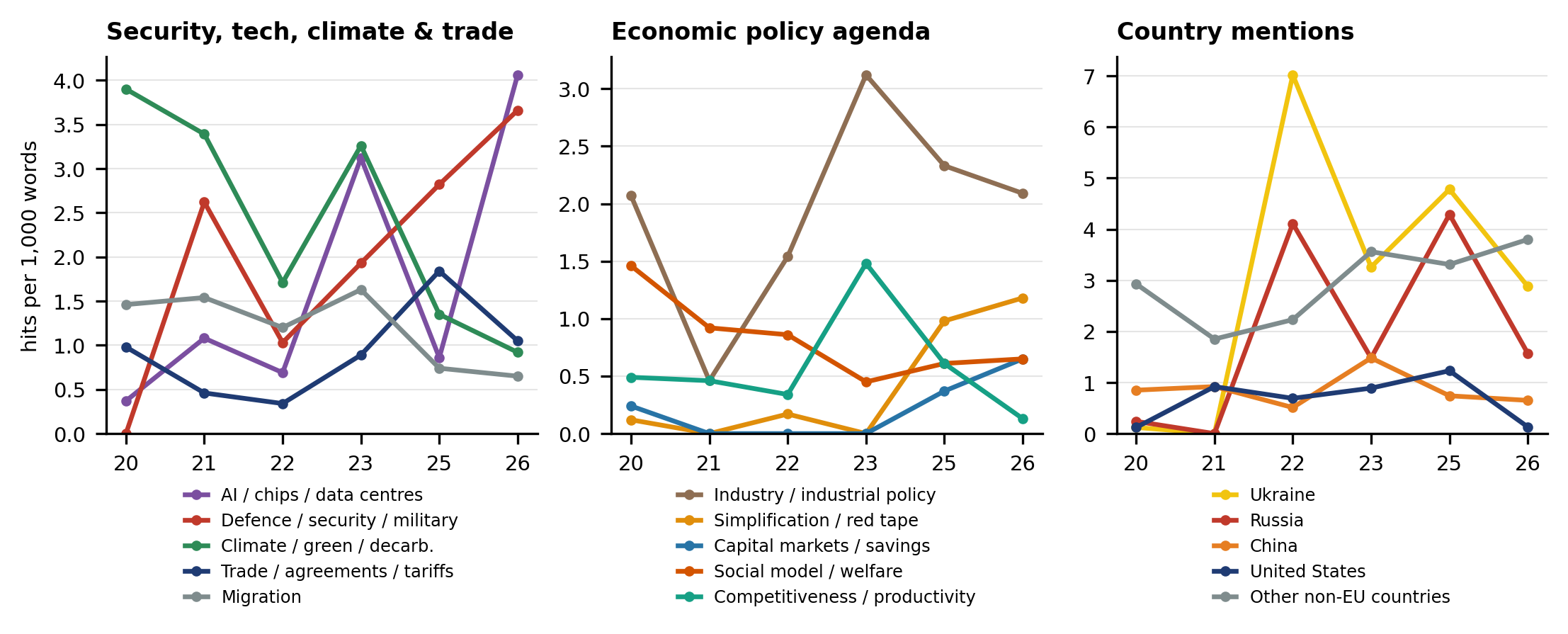
EU policy priorities have markedly shifted. AI unsurprisingly is the new buzzword (Figure 1)[1], as von der Leyen embraces calls for a pace of the frontier and advocates more investment in European computing capacity. Climate language has receded sharply from the highs of the early 2020s, and the discourse has moved more towards climate adaptation, with the announcement of a new “Climate Insurance Alliance”. This is a somewhat overdue recognition of a well-known problem: only about 25% of losses are insured in Europe and EIOPA and the ECB proposed an EU public-private reinsurance scheme already back in December 2024.
Source: Algebris based on SOTEU speeches. Keyword hits per 1,000 words.
Competitiveness and productivity were all the rage in 2023 when the Draghi report was announced, but have since been quietly sidelined, as have many of the former ECB President’s recommendations. Simplification has become a more urgent focus, as reflected in the fast deregulation exercise undertaken last year with the Omnibus exercise. EU capital markets and financial services are back on the map, as Europe needs to advance on a Savings and Investment Union (SIU) to “finance our future”. Those tempted to get their hopes up are warned by the Commission President – and by the unlucky fate of the defunct Capital Market Union project – that “developing capital markets takes time”. In the meantime, the Commission will work on a Banking Package focused on simplification, but the speech makes no mention of the ever-elusive goal of completing the EU Banking Union.
The external dimension of the EU is where the speech is bolder. On international trade, the tone shifts from tariffs towards agreements with alternative trade partners such as India, Mercosur, Mexico, Australia and Indonesia. The geography of the address changes accordingly. The United States is almost absent in this speech, while on China Von der Leyen highlights that trade imbalances have reached a tipping point but stops short of threatening countermeasures – presumably not to jeopardize the Trade and Investment Consultations initiated in the summer.
The undisputed center of gravity in this year’s SOTEU is Canada, to which Von der Leyen offers to become “associate member of the EU”. This denomination currently does not exist, and (reportedly) it was not discussed with EU capitals, so it is hard to know what it means in practice. But if it lands anywhere near what Mark Carney outlined in his own speech before the EU Parliament on the next day, it could be a significant institutional innovation.
On paper, the Commission President seems also set on strengthening the EU security architecture. The idea of a European Security Council is not new, but Von der Leyen floats the idea to open it to like-minded non-EU countries and complement it with a new Emergency Security Protocol, which would be an EU-equivalent of NATO’s Article 4. The speech however offers no details on how these seemingly duplicative structures would interact with (and within) NATO itself.
Ursula von der Leyen borrowed Dickens most famous line (“it was the best of times, it was the worst of times”) to describe a continent that remains resilient despite being pressured on the East by the Russia-Ukraine war, on the West by the threat of US protectionism, and on the South by war in the Middle East. Her speeches over the years tell a story of priorities shifting and adapting quickly, sometimes at the expense of long-term strategic consistency. This year, she painted the picture of a Europe eager to reach outwards, while still soul searching.
Some will argue that it is indeed the worst of times for Europe to be focusing on its external dimension, as big political changes looms and nationalist right-wing parties are increasingly challenging the EU’s raison d’etre. And yet, it is also the best of times to do so, because disruptions in traditional alliances offer Europe the chance to lead in the effort to preserve the multipolar global order which made its very existence possible in the first place. Whether this difficult balance will be struck, will ultimately depend on whether Brussels achieves consistency on its internal policy dimension – which defines what Europe is and stands for.
[1] The analysis covers the six addresses by President von der Leyen (2020–2023, 2025, 2026). Each theme is measured with a narrow word list built around its label. Country counts include demonyms, leaders and capitals (e.g. Putin and Kremlin count as Russia), exclude blocs and regions such as Mercosur or the Western Balkans, and group all other sovereign non-EU states. French and German terms are included for the passages delivered in those languages in 2022 and 2025. Overlapping matches count once, and scores are expressed per 1,000 words to control for speech length.
For more information about Algebris and its products, or to be added to our distribution lists, please contact Investor Relations at algebrisIR@algebris.com. Visit Algebris Insights for past commentaries.
Any opinion expressed is that of Algebris, is not a statement of fact, is subject to change and does not constitute investment advice.
No reliance may be placed for any purpose on the information and opinions contained in this document or their accuracy or completeness. No representation, warranty or undertaking, express or implied, is given as to the accuracy or completeness of the information or opinions contained in this document by any of Algebris Investments, its members, employees or affiliates and no liability is accepted by such persons for the accuracy or completeness of any such information or opinions.
© Algebris Investments. Algebris Investments is the trading name for the Algebris Group.