



A return to tightening
Over the summer, global equities hit a new all-time high, driven by a strong performance in Energy, Large-Cap Tech, and Financials. However, as we entered September, the market turned more cautious, as the drivers of returns shifted to inflation concerns and the long end of the bond market. Renewed escalation in the U.S.–Iran conflict, attacks on Saudi energy infrastructure and growing risks to Red Sea shipping routes pushed Brent crude towards $110/bbl.
US equities remain at all-time highs, driven by a strong Q2 earnings season and recent renewed AI optimism. The Federal Reserve raised rates for the first time since 2023, however this was largely anticipated by the market. Within Tech, August’s weakness in the semiconductor index was compensated with outperformance of the Magnificent 7 and a rebound in Software. An 8th consecutive month of a US Manufacturing PMI above 50 signaled resilient expected growth in fundamentals.
European Equities reversed course from early-August record highs to three-month lows, with rising yields compressing valuations. The ECB raised its key rate to 2.50% and revised its inflation projections higher for the next two years.
In Asia, equities slightly recovered, following the retreat in July. Year to date, Asia leads by a wide margin, with Korea and Taiwan up 65%. As in prior periods, rising earnings have driven performance, while multiples have compressed.
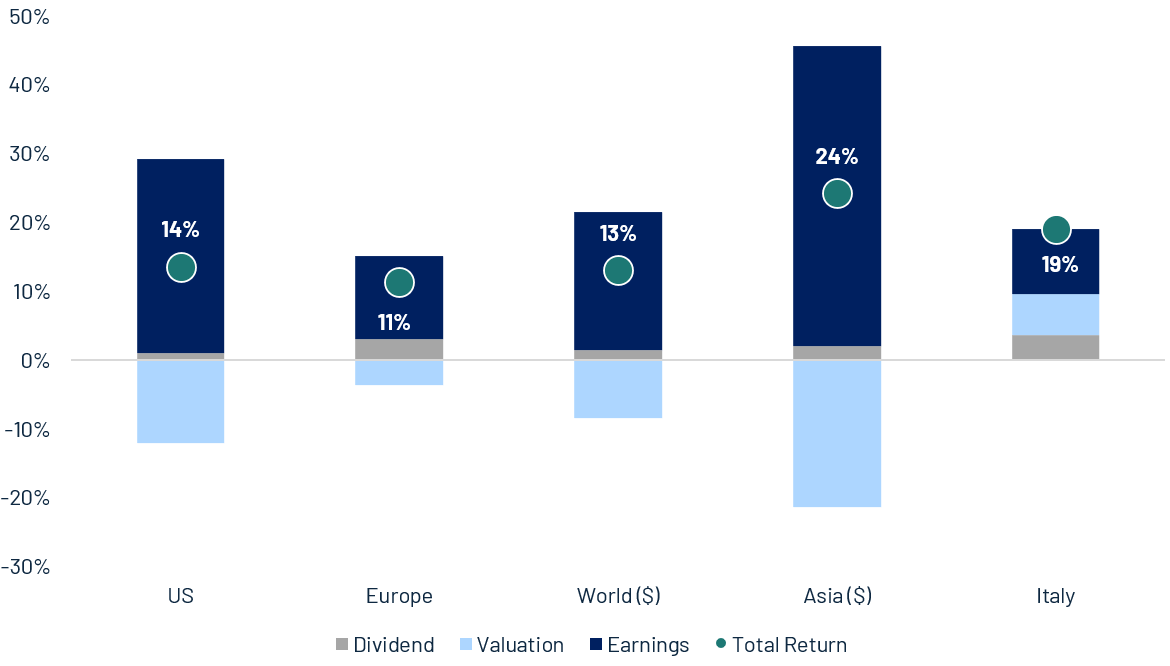
Source: Algebris Investments, Bloomberg Finance L.P, data as 21/09/2026. Performances in local currencies
Why AI and the energy transition are rewriting the market for the “Red Metal”
Bernstein recently reiterated a theme that has been gaining traction across research houses in recent weeks: the copper market will remain in deficit in 2026, before returning to broad balance through 2029, only to reopen more sharply from 2030 onward, when electrification-driven demand will consistently outpace supply growth.
The driver is no longer just the classic green narrative (electric vehicles, renewables, power grids), but a second vector that has gained strength over the past two years: AI data centres. Estimates circulating this year, from BHP to Goldman Sachs, converge on one point: a modern hyperscale data centre can require up to 30 tonnes of copper per megawatt of installed capacity, nearly triple that of traditional commercial infrastructure. BHP itself has estimated that the AI/data centre component alone could add 3.4 million tonnes per year of incremental demand by 2050.
On the supply side, the bottleneck remains structural: it takes 7-10 years to bring a new mine online, while declining ore grades, slower permitting, and geographic concentration of production (Chile, Peru, Congo) limit the sector’s ability to respond.
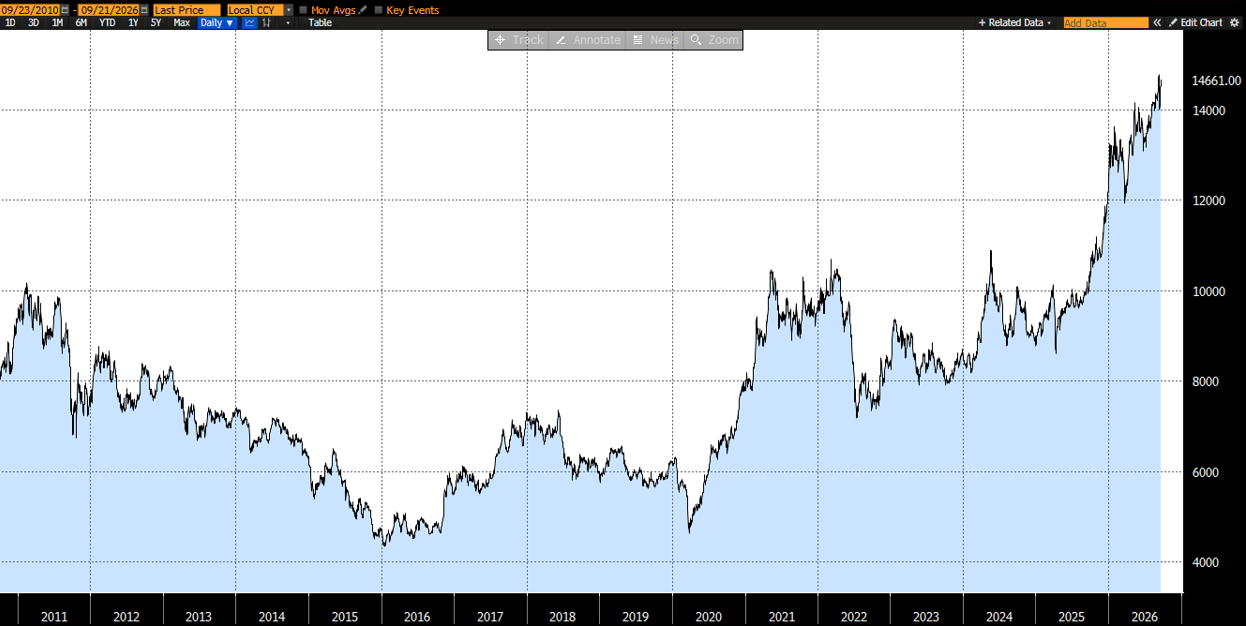
Source: Algebris Investments, Bloomberg Finance L.P, data as 21/09/2026
The H1 2026 Numbers Behind a Structural Shift
If there was any doubt that Chinese automakers have moved from an “emerging challenger” to a “structural force” in the European car market, H1 2026 numbers should settle it. Collectively, Chinese-owned or Chinese-linked brands sold roughly 663,000 vehicles across Europe in the first half of the year, and the growth rates behind that figure are the real story.
MG leads on volume with 180,101 units (+18%), taking its market share to 2.49%. But BYD is closing fast: 172,964 units, up 145%, more than doubling its share to 2.39%. At this pace, BYD could overtake MG within a few quarters.
Further down, growth turns explosive: Omoda/Jaecoo (+224%, 124,280 units) and especially Leapmotor (+569%, 55,744 units), boosted by its manufacturing tie-up with Stellantis. Xpeng (+125%) and Ebro (+277%) show newer entrants scaling fast from a small base. Not everyone is winning, though: DR is down 7%, a reminder that entering the European market doesn’t guarantee sustained growth, especially for brands without a clear technology or price advantage.
Why it matters:
- Local assembly is becoming the edge. Leapmotor’s outperformance suggests European manufacturing presence and the tariff exposure that comes with it now matters more than brand or price alone.
- EU tariffs are the wildcard, already pushing brands toward local plants (BYD in Hungary/Turkey, Chery in Spain) and plug-in hybrids, which face lower duties.
- Pressure on legacy OEMs is real and current, not theoretical: Chinese brands are now accounting for above 5% of total EU sales.
- Not all Chinese exposure is equal. Execution varies widely from one brand to another.
The near-term risk is largely political: further tariff escalation, anti-dumping measures, or reciprocal trade tensions could compress volumes quickly for brands still importing directly from China. The structural trend, the cost to incumbents of falling behind on price and the speed of EV/PHEV rollout, looks intact regardless.
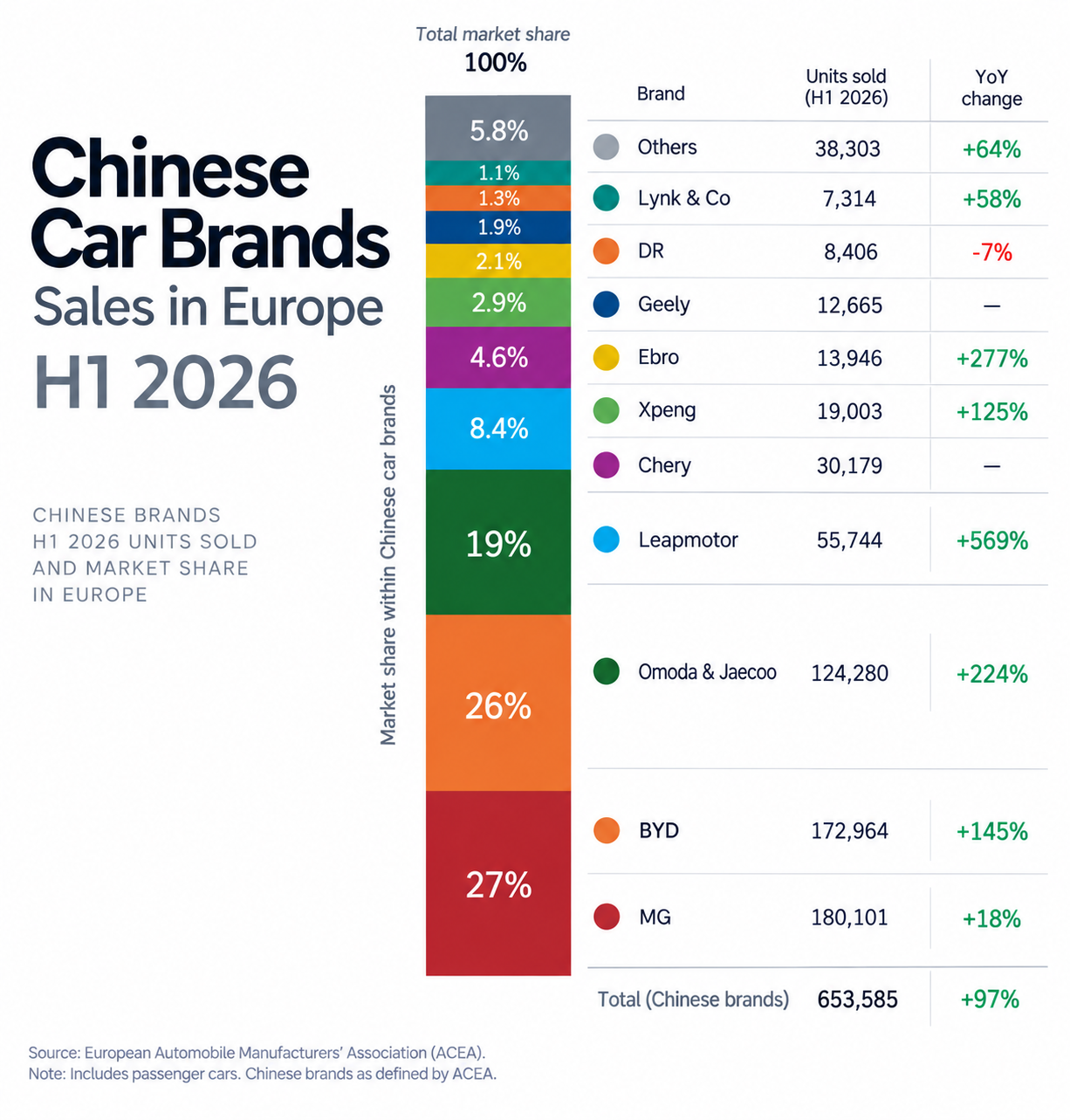
Chinese car brands sales in Europe H1 2026
Source: European Automobile Manufacturers’ Association (ACEA).
Note: Includes passenger cars. Chinese brands as defined by ACEA.
Algebris Investments’ Global Equity Team
For more information about Algebris and its products, or to be added to our distribution lists, please contact Investor Relations at algebrisIR@algebris.com. Visit Algebris Insights for past commentaries.
Any opinion expressed is that of Algebris, is not a statement of fact, is subject to change and does not constitute investment advice.
No reliance may be placed for any purpose on the information and opinions contained in this document or their accuracy or completeness. No representation, warranty or undertaking, express or implied, is given as to the accuracy or completeness of the information or opinions contained in this document by any of Algebris Investments, its members, employees or affiliates and no liability is accepted by such persons for the accuracy or completeness of any such information or opinions.
© Algebris Investments. Algebris Investments is the trading name for the Algebris Group.
