
The end of French exceptionalism?
On 31 May 2016, the former President of the European Commission Jean-Claude Juncker was asked why Brussels was so lenient on France’s repeated breaching of EU fiscal rules. The answer was short and telling: “Parce que c’est la France (Because it is France)”[1]. Ten years later, French public spending has reached 57% of GDP against a Eurozone average of 50%, the fiscal deficit stands at a above 5% of GDP against 2.9% for the Eurozone as a whole, and France is the only G7 country where the debt to GDP ratio is higher today than it was in 2020 at the peak of the COVID-19 pandemic. For two decades, Paris has enjoyed an exceptional privilege within the Eurozone: that of running a generous fiscal policy without ever being held accountable for it – neither by Bruxelles, nor (until now) by markets.
As government debt started to sell off sharply in fall 2026, this French exceptionalism seems to be over. The spread between 10-year French and German government bond yields (OAT-Bund spread) started the month at around 86bp and climbed to 160bps in October. With the yield on the 10-year OAT breaching the 5% level for the first time in more than 20 years, France at present pays more to fund its debt then all former members of the Euro Periphery. It also pays more than its official AA- credit rating would imply – suggesting that the markets may have already priced in a negative outcome from the impending credit rating decisions (Figure 1). The annual cost of insuring French government debt against default over five years conveys a similar message, with CDS prices having roughly doubled since mid-September to about 77bp – in line with countries rated in the BBB zone.
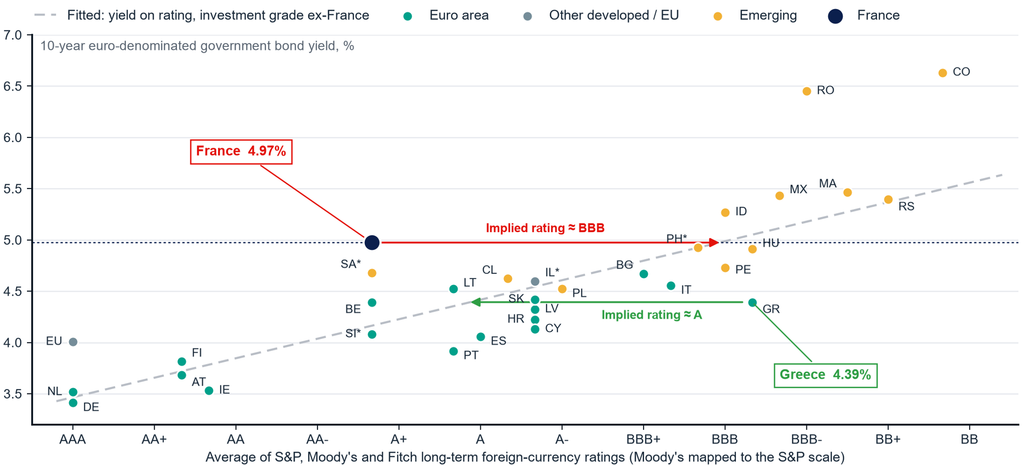
Figure 1. 10-year euro-denominated government bond yield against average sovereign credit rating (S&P, Moody’s, Fitch). Source: Bloomberg, 19 October 2026. Germany, France, Italy, Spain, Portugal, Belgium, Netherlands, Austria, Finland, Ireland, Greece: generic 10-year benchmark yields. Other sovereigns: EUR-denominated fixed-coupon bonds of at least EUR 500m, yield interpolated to 10 years between the bonds either side (* = interpolation across a gap of more than 4 years). Ratings: issuer ratings (Bloomberg). Fit: OLS of yield on rating notch across 29 investment-grade sovereigns excluding France. Non-euro-area issuers’ EUR bonds are mostly foreign-law eurobonds and less liquid than OATs. Chart: Algebris Investments.
This is not just a French manifestation of the global bond selloff. While bond yields have indeed been on the rise everywhere – driven by growing global debt burdens, massive hyper-scaler issuance, fears of inflation and tighter monetary policy – in France, the main driver seems to be a repricing of the country’s fiscal risk. Across the prior episodes of global selloffs that were unrelated to European shocks, French yields have historically moved in line with German ones – the 10-year OAT rising between 0.7 and 1.6 times as much as the Bund did[2]. That tight link held even in largest episodes: in the 2013 taper tantrum, when Bund yields rose by 88bp, French yields rose by 96bp (1.1x). But not this time. During the global selloff that took place between the end of August and early October, he 10-year US Treasury yield climbed by 49bp and the Bund yield by 14bp, but French yields rose by 63bp – almost 5 times the Bund’s own move (Figure 2). Only one fifth of the increase in French yields during the latest global selloff can be attributed to global factors, with the rest reflecting genuine French idiosyncratic risk. As further evidence of this, OAT yields kept climbing even after the Treasuries and the Bund had started to retrace.
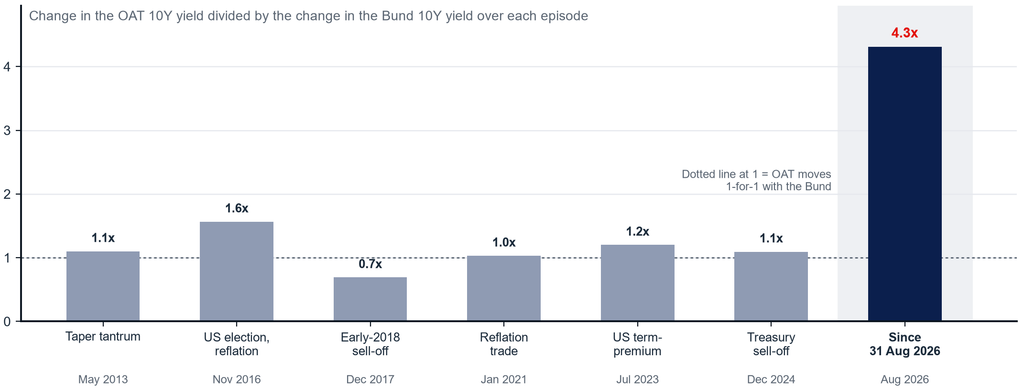
Figure 2. Ratio of the OAT and Bund change in 10-year yields into episodes of global bonds selloff, versus the current event. Source: Bloomberg generic 10Y yields. Global bond sell-offs driven by US and global rates, start to end of each episode; H1 2022 excluded (ECB exit from QE: euro-specific). Past episodes: ratio between 0.7x and 1.6x, average 1.1x. Current episode: 31 August to 09 October 2026, Bund +16bp, OAT +68bp. Chart: Algebris Investments.
The Politics of Chaos
The deterioration of French fundamentals has been a slow process. What sets this episode apart is politics. The 2027 parliamentary budget discussion is in fact exposing the deep polarisation of the French political system, which will carry over into and after the upcoming presidential election (Figure 3, right). The government budget proposal aims for 54 bn of savings, but six months ahead of elections no party in parliament seems keen to get the blame for “austerity” measures against which the French have started to take to the street.
On 21 September, secondary-school pupils in deprived areas of Paris began boycotting classes over shortages and run-down conditions. Within two weeks, the boycotts had spread nationwide, with teachers and trade unions joining the protest and clashes happening outside schools. On Saturday 17th October, about 550,000 people marched across France, 110,000 of them in Paris. The protest escalated into violence, looting and arson. The 143-years old town hall in the city of Limoges was largely destroyed, Marseille’s city hall was stormed, and almost 2,400 people were arrested. After a second day of unrest, Prime Minister Lecornu imposed partial curfews.
The protests that have erupted in the past weeks raise the political cost of supporting spending cuts. Absent political agreement in the National Assembly, the government can force the budget through by means of Article 49.3, which adopts the text unless a censure motion wins an absolute majority. Article 49.3 has become almost routine in French budgetary process, but this time it is risky. The Socialists have threatened to support a censure, while Rassemblement National’s leader Le Pen has so far kept her options open on the matter and would be pivotal. A successful censure motion would take the budget down with the government – leaving France no option but to roll over the 2026 budget, which would widen the deficit at a time when perceived fiscal risk is already driving yields higher.
Faced with the risk of a budgetary failure, the government could resort to a “nuclear option”. Iif Parliament has not decided on the budget within 70 days of it being tabled (ie. around mid-December), the government can in fact force the budget through by ordinance, under Article 47. This route has never been used in the Fifth Republic, and it would most likely lead to a censure motion that the government would lose. But unlike under Article 49.3, the budget enforced by ordinance would survive the fall of its government. On one hand, France would have a moderately tightening budget in place through the pre-election period – which would reassure markets and facilitate any conversation with EU institutions. On the other hand, the broader consequences of using an untested power at a time of civil unrest are obviously hard to predict.
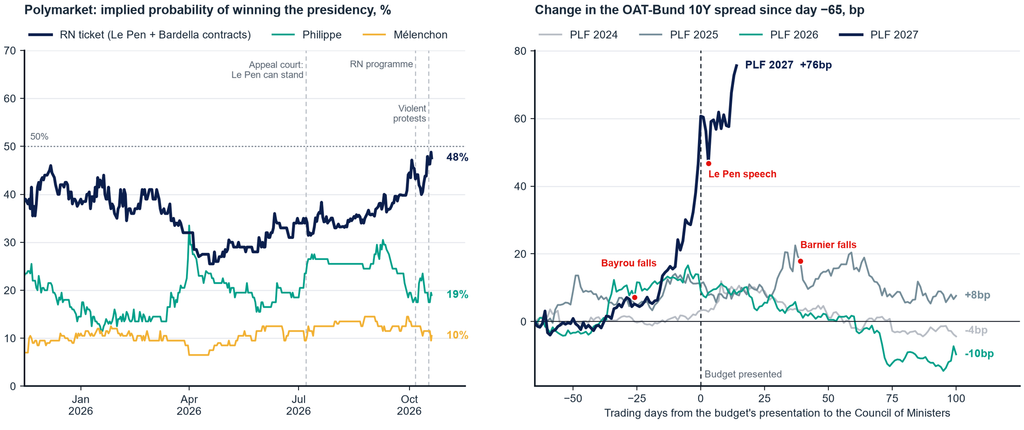
Figure 3. Presidential winning odds (left) and 10-year OAT-Bund spread into four episodes of budget negotiations (right). Left: Polymarket, “Next French Presidential Election” (resolves to the winner). Yes-token prices, daily at 00:00 UTC; last point = order-book midpoint on 19 Oct 2026. RN ticket = Le Pen + Bardella contracts. Implied probabilities before fees, not adjusted for the overround. Launch day (14 Nov 2025) excluded. Right: Bloomberg (GFRNI10 minus DGBR10). Day 0 = draft budget (PLF) to the Council of Ministers: 27 Sep 2023, 10 Oct 2024, 14 Oct 2025, 1 Oct 2026. Widening from day -65 to day 0: PLF 2024 +3bp, PLF 2025 +1bp, PLF 2026 +9bp, PLF 2027 +61bp. Daily to 19 October 2026. Chart: Algebris Investments.
The Receding Horizon
Beyond the fog of the budget negotiation, the focus is on the 2027 Presidential election. Seven months before the first round, the latest polls put Marine Le Pen clearly ahead, at 32–36% of first-round voting intentions, with Jean-Luc Mélenchon (15–18%) and Édouard Philippe (13–23%) competing for second place[3]. In the second round, Le Pen is projected to beat both those opponents (Figure 3, left). The possibility of a run-off between two populist candidates at the far-right and far-left ends of the French political spectrum, has caught market attention. Mélenchon’s programme includes “disobeying” EU fiscal rules, sizeably increasing public spending, and cancelling the roughly 18% of French public debt currently held by the Banque de France – a plan that would endanger France’s continued membership in the euro. For bond investors, the question has thus shifted to whether, in a run-off against Mélenchon, Le Pen could be credibly relied upon as the fiscally conservative candidate. Her latest campaigning on the subject suggest that she has become keenly aware of it.
Rassemblement National’s recently released fiscal platform ticks all the boxes to sound hawkish on fiscal. The plan promises €140bn of net savings by 2032, almost half of it to be carried out in the first year (€66bn, or 2.1% of GDP, in 2027). The deficit would fall from 5.4% of GDP in 2026 to 3.7% in 2027 and 2.2% in 2032, with a primary surplus from 2028, and debt would decline from 119% of GDP in 2027 to 112% in 2032. The savings would supposedly pay for €53bn of tax cuts in 2027, and for €16bn of new spending. The entire consolidation effort would be anchored by a fiscal “golden rule” to be adopted by referendum, which would force a minimum fiscal adjustment of 0.5% of GDP if debt is above 60% of GDP.
This may sound too good to be true. An independent assessment from Institut de l’Entreprise finds that about 80% of the savings claimed for 2031 in the plan are undocumented, legally shaky or have no actual effect on the deficit[4]. The credible savings are estimated at a much lower €3bn in 2027 and €7.5bn in 2031, and on that basis the deficit would reach 6.5% of GDP in 2031, with the debt ratio reaching close to 130%. But the biggest reason for scepticism, is probably the same that got France where it is now: “because it is France”. Othe past 20 years, every vintage of France’s fiscal projections has promised to deliver fiscal consolidation, but the horizon has been constantly receding (Figure 3). The 2027 adjustment promised by RN would be about double the largest annual cut in the deficit that France has ever delivered outside a post-crisis recovery, where adjustment mostly meant phasing out extraordinary support (1.1% of GDP in 2018). And it would have to be delivered starting from mid-year.
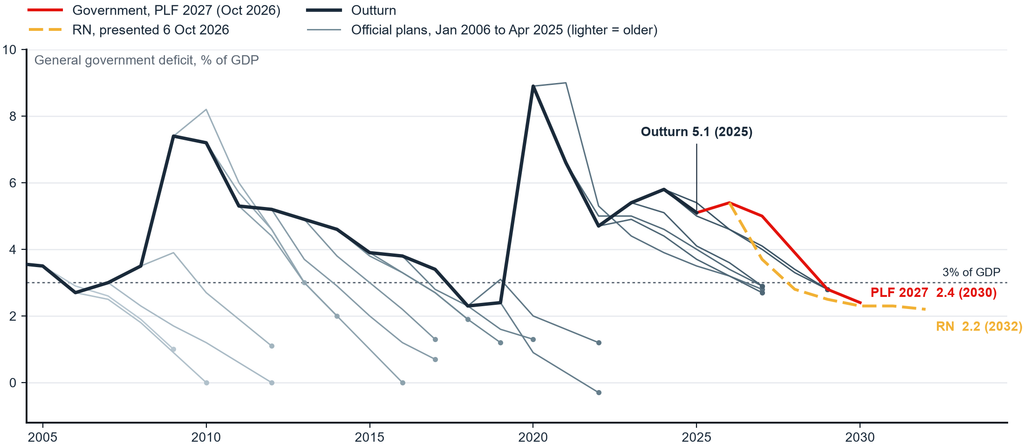
Figure 4. France’s promised fiscal adjustment over 20 years of Stability Programmes, versus the realised fiscal deficit
Source: French Stability Programmes Jan 2006 to Apr 2024, medium-term fiscal-structural plan Oct 2024, annual progress report Apr 2025 (Trésor, budget.gouv.fr, European Commission); PLF 2027 and annexed RESF (2028-30 path described as contingent in RN presentation of 6 Oct 2026). Outturn: actual deficit per Eurostat gov_10dd_edpt1 (April 2026 notification), including all subsequent statistical revisions. Each plan is drawn from the outturn for the last year completed at publication, followed by its official targets. The 2006-07 programmes give low- and high-growth scenarios; the low-growth (reference) scenario is shown. The April 2020 programme (2020 only, no medium-term path) is not shown. Chart: Algebris Investments.
A Le Pen victory in fact may not fully settle the question of who governs France, prolonging uncertainty. A new president would likely dissolve Parliament and call elections in June 2027. The polls suggest those elections would not necessarily give RN a majority[5] and President Le Pen could find herself with a hung parliament, dominated by hostile blocs with widely diverging views on fiscal policy. Getting sizeable budget cuts through such a parliamentary setting would be difficult. France has been forcing its budget through Parliament without a vote since 2022, but that has led to the demise of two governments in less than a year. The biggest risk is therefore that a persisting and deepening political fragmentation could paralyse French economic policy post-election and put French debt on a rising trajectory.
Low Budget for Errors
On paper, both the current government plan and the RN’s one look reassuring, but there is little room for error. The 2027 PLF keeps public debt stable at around 120% of GDP, and RN’s plan would bring it down to about 110% by 2035. But the gap between promise and delivery could widen quickly, in an environment of raising rates. When considering only those fiscal measures in the plans that independent assessments deem to be credible[6], the debt trajectories at current rates would converge towards 140% – in line with what the European Commission projects in a no-policy-change scenario (Figure 4)[7].
The decisive uncertainty in France’s fiscal outlook therefore lies in the credibility of implementation. When looking at Le Pen, markets see the reassuring metamorphosis of fellow right-winger Giorgia Meloni in the rearview mirror. The BTP-Bund spread climbed to roughly 250bp in September 2022 on the result of the Italian legislative election, but it quickly decreased as it became evident that the Meloni government had no intention to open a confrontation with Brussels on fiscal policy and was set on keeping the books in order. Using Italy as a reference of what will happen in France, however, may be a mistake. Italy has managed to achieve a primary surplus in 29 out of the last 35 years, and it has a history of resorting to non-partisan technocratic governments when politically difficult adjustment needs to be delivered. France only ran a primary surplus in 4 of the last 35 years, the most recent of which in 2001, and compromise on fiscal adjustment seems elusive. Le Pen’s hawkish fiscal act may have got her the benefit of the doubt, but the spread relief from the RN budget presentation has been short-lived.
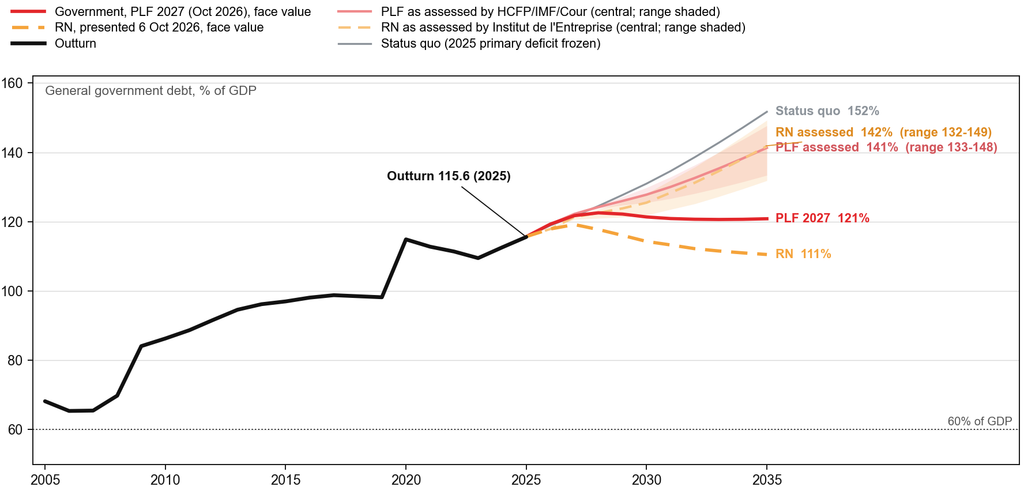
Figure 5. France’s debt trajectory under alternative scenarios, starting from the government and RN’s budget plans.
Source: Eurostat (gov_10dd_edpt1, April 2026 notification) for the outturn; DSA model (FR bonds/06_DSA) for projections. Government: PLF 2027 and RESF 2027 multi-year path (2028–30 described as conventional), held after 2030. RN: press kit of 6 October 2026, held after 2032. Assessments: government = HCFP aviz 2026-5 (2027 growth 0.8%, deficit 5.25%) then primary improvement of 0.8pp/y (IMF Article IV pace, high), half (central) or none (low); RN = Institut de l’Entreprise costing of 6 October 2026 (credible net savings EUR 7.5bn vs 14.7bn shown in 2031; range -25 to +50bn), at RN growth. All projections at a 10-year OAT yield of 4.8% from 2027 (issuance rate = 10y − 0.3pp; bills 6% of debt); programme growth assumptions as published. Status quo = 2025 primary deficit (2.9% of GDP) frozen. Chart: Algebris Investments.
The ECB to the rescue?
Against this complex and politically uncertain background, questions have emerged on whether the ECB could intervene to curb French yields by deploying its spread-compression tool (the Transmission Protection Instrument – TPI) that allows unlimited intervention in a jurisdiction facing “unwarranted, disorderly market dynamics”. This is unlikely to happen absent credible fiscal commitments from France and a larger widening in spreads.
TPI exists to shelter Eurozone countries against undue panic, not against the cost of their own fiscal policy. As such, access is subject to requirements – including compliance with the EU fiscal framework. On a formal test, France currently qualifies: although it has been under an Excessive Deficit Procedure (EDP) since July 2024, in its latest assessment the EU Commission concluded that Paris had taken effective action and placed the procedure in abeyance. Assuming that a moderately restrictive budget can be passed (or forced) through parliament before end-year this would arguably continue to be the case into the pre-election period. But at what point does a repricing of French risk against deteriorating fiscal fundamentals, a fragmented parliament and a possibly unenforceable fiscal consolidation plan turn from rational to unwarranted?
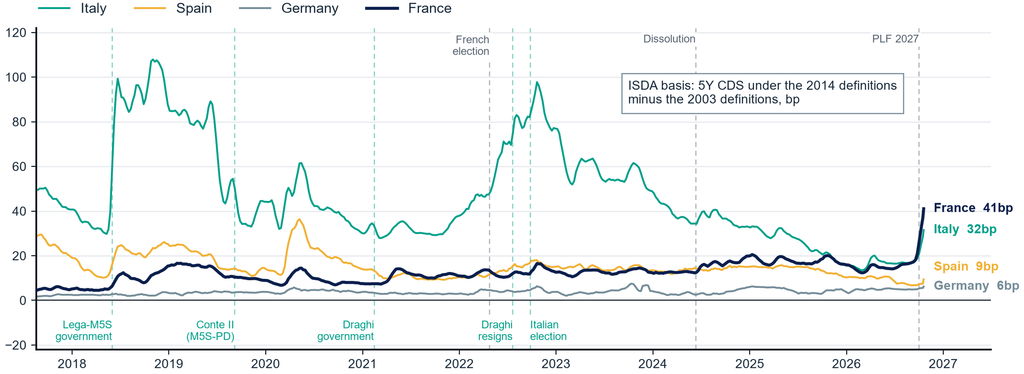
Figure 6. Redenomination risk as proxied by the ISDA basis indicator
Source: Bloomberg (5Y USD sovereign CDS under the 2014 and 2003 ISDA definitions), weekly medians, 4-week average, to 19 October 2026. Measure as in Corradin, Grimm and Schwaab (ECB). Chart: Algebris Investments.
The final decision is about whether a widening of spread is justified by fundamentals, on which the Governing Council retains full discretion. Here, the ECB will face a dilemma. On one hand, activating TPI for France absent a credible commitment to future adjustment would expose the ECB to the risk of fiscal dominance and legal challenges like those previously brought against PSPP. On the other hand, waiting on the sidelines for too long could create the risk that a repricing of French risks turns into a broader financial stability event. For now, French risk seems to remain contained in France (Figure 5) but if it were to spill over Euro members, the ECB may consider deploying TPI on other Euro members while holding the line on France.For these countries, contagion from French risk at this time would constitute an exogenous funding shock unrelated to their own fiscal policy – which is arguably the very kind of shock TPI is meant to address. The case for using TPI to prevent spillovers is very strong.
Looking Ahead
The raise of French fiscal risk is bringing back the attention to Europe, where the autumn of 2026 is promising to be a hot one – in terms of both actual and political temperature. Yet concerns of systemic spillovers are unwarranted. The Eurozone institutional architecture today is significantly more solid than at the time of the Euro crisis. An entire institutional framework was set up to avoid a repetition of past crises – with the European Stability Mechanism (ESM) at its centre, acting as lender of last resort to sovereigns. The ECB today also has a much bigger arsenal of bond-buying tools at its disposals – both for “normal times” and for crisis times. Most importantly, the ECB has demonstrated the will to be proactive and creative in the use of its tools. The choice to deviate from the theoretical share implied by a strict application of the capital key rule in the context of the Pandemic Emergency Purchase Programme is an example of such change in attitude. The repricing of French debt may continue as long as uncertainty persists on the future fiscal trajectory, but in the context of a much stronger Eurozone institutional architecture with a more proactive ECB, this is unlikely to morph into a broader Euro event.
[1] See: https://www.reuters.com/article/business/eu-gives-budget-leeway-to-france-because-it-is-france-juncker-idUSKCN0YM1MZ/
[2] To test whether the recent rise in French yields reflects more than the global sell-off, we compare it with six earlier episodes in which government bond yields rose worldwide for reasons unrelated to Euro-specific risk: the 2013 taper tantrum, the reflation trades of 2016 and 2021, the global sell-off of early 2018, the rise in US term premia in 2023, and the Treasury sell-off of December 2024 and January 2025. For each episode we measure the change in the 10-year French and German government bond yields between its first and last trading day and compare the two. We reach the same conclusion with a second, statistical approach. Using daily data from January 2023 to May 2024, a period free of French political shocks, we estimate how French 10-year yields typically respond to moves in core euro-area and US yields and apply those sensitivities to the moves since the end of August. Global and euro-area factors account for about 20–25bp of the rise in French yields, leaving about 50bp specific to France. That is about four times the largest France-specific move in any comparable period of 2023–24.
[3] Toluna Harris Interactive, 22–24 September; Ifop-Fiducial, 25–29 September; Ipsos bva, 3–9 September
[4] Institut de l’Entreprise, “Contre-budget du RN : 140 milliards affichés, moins de 10 milliards crédibles », note de contexte, 6 Octobre 2026.
[5] The latest legislative voting-intention polls put the RN and its allies at 33–36% in the first round. The left is at about 24%, the centre at 14% and the Republicans (LR) at 12% (Ifop-Fiducial, October 2025; poll averages since then show little change). In 2024 a similar first-round score of 33% left the RN third in seats: about 220 left-wing and centrist candidates withdrew to block it in the second round, and it won only 143 seats. Vote-Scope projects about 285 seats for the RN and its allies if voters coordinate against it as they did in 2024, just short of a majority, and about 310 if that coordination weakens.
[6] “Credible” measures are taken from independent assessment of eac plan. For RN: Institut de l’Etreprise, costing of the RN counter-budget (6 Octobre 2026). For PLF: for 2027 w use the Haut Conseil des Finances Publiques (avis 2026-5, 1 Octobre 2026); beyond 2027, the best case assumes that the primary balance improves in line with the pace recommended by the IMF in its May 2026 Article IV, the base case assumes half that pace, and the worst case assumes no further measures (in line with the transparency mission’s projections, July 2026).
[7] European Commission Debt Sustainability Monitor 2025
For more information about Algebris and its products, or to be added to our distribution lists, please contact Investor Relations at algebrisIR@algebris.com. Visit Algebris Insights for past commentaries.
Any opinion expressed is that of Algebris, is not a statement of fact, is subject to change and does not constitute investment advice.
No reliance may be placed for any purpose on the information and opinions contained in this document or their accuracy or completeness. No representation, warranty or undertaking, express or implied, is given as to the accuracy or completeness of the information or opinions contained in this document by any of Algebris Investments, its members, employees or affiliates and no liability is accepted by such persons for the accuracy or completeness of any such information or opinions.
© Algebris Investments. Algebris Investments is the trading name for the Algebris Group.